
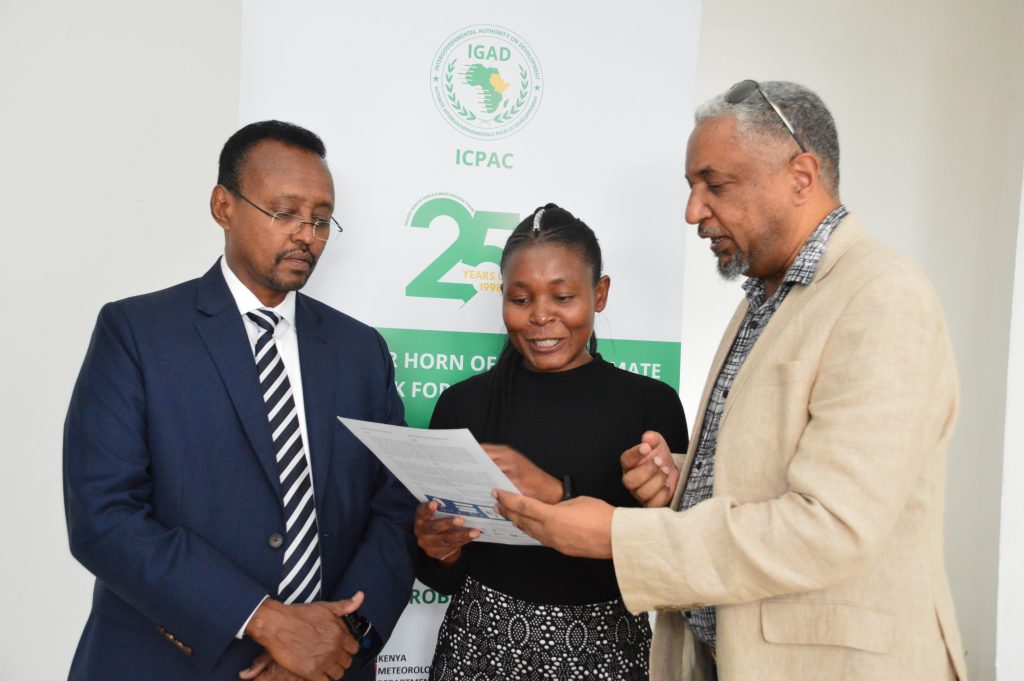
At the 65th Greater Horn of Climate Forum which was convened as a hybrid event on 22nd August 2023, IGAD Climate Prediction and Applications Centre (ICPAC) announced that the October to December 2023 climate forecast shows high chances of wetter-than-usual conditions across most parts of the Greater Horn of Africa.
It was noted that there was an 80% probability of experiencing wetter-than-usual rainfall in Southern Ethiopia, Eastern Kenya, and Southern Somalia. On the other hand, probabilities also indicate drier-than-usual conditions for isolated areas of Southwestern Uganda and southwestern South Sudan.
Flooding in the areas will be attributed to the heavy rainfall experienced across much of the regions from March to May (MAM) 2023 and the increased precipitation from October to December (OND) 2023
Dr. Guleid Artan, ICPAC Director, noted, “We have now entered El Niño conditions which, for Eastern Africa, are synonymous with wetter conditions during OND.
After three years of devastating drought, this may be seen as a blessing for farmers. Still, it can quickly become a curse as desert locusts are already proliferating to alarming levels in parts of the region. The risk of deadly incidents also increases significantly.”
He reminded us of the last El Niño in 2015/16 when downpours of torrential rains caused landslides, flash floods, and buildings to collapse hence advised the governments and disaster management agencies to take all necessary measures to save lives and livelihoods.
Dr. Hussen Seid, Climate Modelling Expert at ICPAC, added: “El Niño is a climate phenomenon characterized by the periodic warming of sea surface temperatures in the central and eastern equatorial Pacific Ocean. Its effects can influence weather patterns worldwide.
Another significant phenomenon known as the Indian Ocean Dipole is developing over the Indian Ocean and will reinforce the El Niño impacts.”
October to December constitutes a vital rainfall season, particularly in the equatorial parts of the Greater Horn of Africa, contributing 20-70% of the annual total rainfall. The start of the season will likely occur early in parts of the region where elevated rainfall is anticipated (eastern Kenya, southern Somalia, and eastern Tanzania).
In contrast, probabilities favor an average or delayed onset over parts of northern Somalia, western Kenya, Uganda, southern South Sudan, Rwanda, Burundi, and north-western Tanzania.
ICPAC is a designated Regional Climate Centre for Eastern Africa by the World Meteorological Organization. Its seasonal forecast is based on rigorous analysis of historical data, prevailing climate signals, and advanced modeling techniques.
For OND 2023, the consolidated objective temperature forecast from nine Global Producing Centres (GPCs) indicates an increased likelihood of warmer-than-usual surface temperatures for almost all parts of the Greater Horn of Africa, particularly over Djibouti, Eritrea, northern Ethiopia, northern Somalia, and parts of coastal Tanzania.
The report was brought forth at a forum that brought together climate services providers and users from key socio-economic sectors, government and non-governmental organizations, stakeholders, and others to discuss impacts and mitigation measures for the upcoming season.