
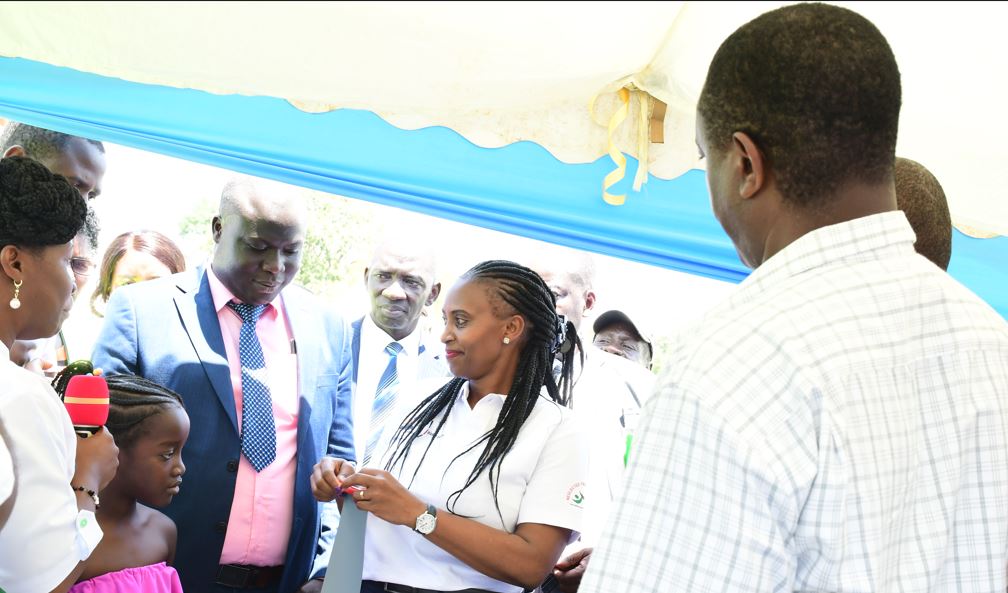
drug administration (MDA) initiative at KMTC grounds, Siaya town Wednesday.
The government is committed to eradicating Neglected Tropical Diseases(NTDs) by 2030.
While addressing the community Health volunteers at a campaign launch on Wednesday 24th August 2023 of the lake region’s community-based mass drug administration (MDA) initiative at KMTC grounds in Siaya town. , Principal Secretary for Public Health and Professional Standards Ms. Mary Muriuki, lauded the country for having accomplished remarkable milestones amongst them being certified Guinea Worm Free in 2018.
The initiative is aimed at combating intestinal worms and bilharzia.
“In this battle, I would urge each one of us to keep in mind our children, who are particularly vulnerable to contracting bilharzia and intestinal worms due to their exposure to contaminated water and insufficient hygiene practices,” said Ms. Muriuki
The country is at risk of becoming infected with the disease as statistics show that a total of 15 counties, six in the Coastal region, four in the Western region, and five in the Lake region have been mapped out by the Ministry of Health as in need of urgent intervention in regards to Bilharzia and Intestinal worms.
Globally, 800 million people are at risk of contracting bilharzia with 254 million already infected Kenya stands at 10 million people at risk of bilharzia while 20 million others risk contracting intestinal worms.
Data shows that, in the Coastal region out of 130 wards, 81 and 72 wards require treatment for intestinal worms and bilharzia respectively.
On the other hand, 139 and 40 wards out of the 155 wards in the Western region need treatment for intestinal worms and bilharzia respectively while the Lake region exhibits similar urgency with 145 and 98 Wards out of 170 wards requiring treatment for intestinal worms and bilharzia respectively.
The campaign launched Wednesday is scheduled to take place from August 24th to 27th, 2023 and many stakeholders deem it a big step in the fight against Neglected Tropical Diseases (NTDs).
Neglected Tropical Diseases (NTDs) are a devastating obstacle to human settlement and socioeconomic development of already impoverished communities. Interventions against NTDs mostly in the form of mass distribution of medicines donated by pharmaceutical companies have already benefited millions of people, protecting them from physical pain, disability, and poverty. Over the past decades, the World Health Organization (WHO), together with its partners, has formulated an innovative strategy to ensure cost-effective, ethical, and sustainable control toward the elimination or eradication of several NTDs.
Neglected tropical diseases (NTDs) are a group of chronic disabling infections affecting more than one billion people worldwide, mainly in Africa and mostly those living in remote rural areas, urban slums, or conflict zones.
Beyond their negative impact on health, NTDs contribute to an ongoing cycle of poverty and stigma that leaves people unable to work, go to school, or participate fully in family and or community life.
They range from Trypanosomal parasites to helminth parasites, Bacterial infections, and Viral infections.
The diseases are called neglected because, compared with malaria, HIV, and TB, they have received relatively much less funding or attention from national governments and medical and donor communities despite the vast numbers of people affected.
Lacking a strong political voice, people affected by these tropical diseases have a low profile and status in public health priorities. The lack of reliable statistics and ‘unpronounceable’ names of diseases have all hampered efforts to bring them out of the shadows.